Tag: COVID-19

Necessary Travel in a time of COVID-19

International Travel

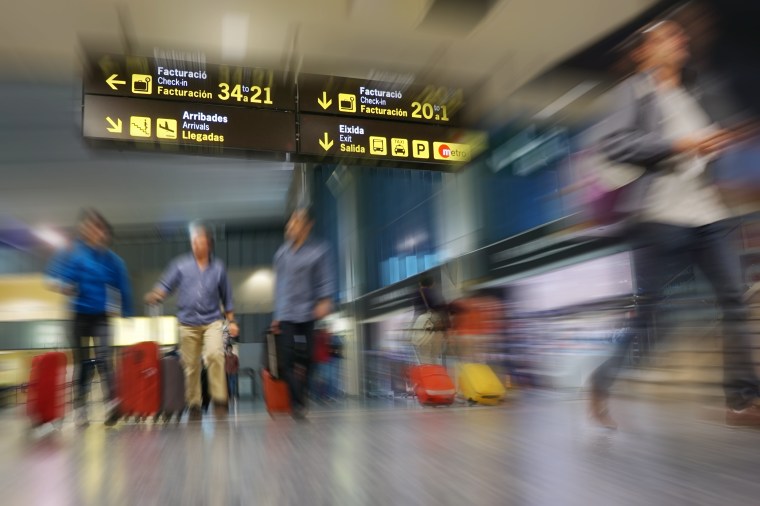
Airline Passengers in an International Airport

At long last, Prime Minister Justin Trudeau has announced that he will finally exempt spouses, children, and parents of citizens and permanent residents from the COVID-19 border closure with the U.S. Since my husband is Canadian and in Ontario right now, and I’m American and in Florida right now, this is news we have been anticipating in agonizing fashion. Immediate family is no longer “non-essential,” (note to government officials – THEY NEVER WERE.) So now that I have necessary travel to embark on the question is, in this time of Coronoavirus, how can I traverse across a continent safely? My car is stranded in Canada, so a road trip, which would be my first, and the safest choice, is not an option. One bit of good news is that ALL of the below options have ramped up deep cleaning measures on their modes of transportation.

Option 1: Air Travel

Air travel is the type of travel I’m most leery of right now from a health standpoint. Airlines originally promised to leave middle seats empty, but have proceeded to fill those seats and pack the limited number of planes they have running as full as possible to help recoup their losses – despite the danger they’re placing on their customers. I’ve never been one for flying, unless I was crossing an ocean and had no choice. Being crammed in a tightly cramped space with random strangers, some of whose behavior and hygiene left something to be desired, and dealing with endless lines at security checkpoints, was never my idea of a “good time.” And now, with the news being inundated with reminders of social distancing, staying six feet apart, and even laws requiring the aforementioned, it has made me wonder for a while now why airports are not closed all together. It is the single type of business still open where it is literally impossible to social distance. Do I really want to place serious risk on my health, and that of my husband, getting on a plane? Or risk denial of entry into the country because I’m “showing symptoms?” According to the Centers for Disease Control, “Social distancing is difficult on crowded flights, and you may have to sit near others (within 6 feet), sometimes for hours. This may increase your risk for exposure to the virus that causes COVID-19.” (cdc.gov) Airlines scoff at the idea that it isn’t safe – but it doesn’t take a PhD in rocket science to see the risk factors. Masks are required, but if people are allowed to take them off during food and beverage service, what’s the point?

PROS: Air is well ventilated and circulated. Travel between destinations is fast, reducing your exposure time-wise. The only option (besides car) that is currently crossing the U.S./Canada border.

CONS: Extremely close quarters, zero control over social distancing for the passenger, zero control over what other passengers are in near proximity (if you’re seated next to someone coughing, you’re out of luck!) Least amount of personal space and freedom to move about. The aggravation of dealing with airport security checkpoints.

Electric passenger train drives at high speed among urban landscape.

Bullet Train

Option 2: Train Travel

I have another option – train travel on Amtrak. Although Amtrak has temporarily halted service to routes crossing the Canadian border due to the limited categories of people currently allowed passage, I could take the train to Buffalo, New York and cross the Peace Bridge on foot, where my husband would be waiting on the Canadian side in his car. (Service to Niagara Falls, with a shorter pedestrian bridge, is also suspended.) On a train, you have the most freedom to move around. Even if you’re seated near people in the main cabin, you can try to find a better spot in the Observation Lounge, or head for the cafe or restaurant. And even if you remain in your seat, your “personal space” is greater than on a plane or bus. You also avoid standing in potentially crowded security checkpoints. Masks, again, are required – but, again, people are allowed to take them off while eating and drinking. The downside? LONG travel times. According to Google Directions, my train trip from Tampa Bay to Buffalo would take two days, as compared with a couple of hours on a plane. The route would require going up the Eastern Seaboard rather than a more direct route. And the layover point is in the COVID-19 epicenter: New York City. While a train ticket would be cheaper than an airline ticket, I would expect to be exhausted upon arriving in Buffalo – and would definitely reserve a hotel room for that point in the trip. This would jack the cost up beyond the cost of an airline ticket.

PROS: More room in your seat. The freedom to move around, and go to a completely different area if you find yourself near someone you consider a health risk (or annoyance!) Avoiding long lines at customs security checkpoints potentially with no social distancing measures. Most appealing option for my work as a blogger and YouTube creator.

CONS: Increased potential exposure due to long travel times. Long travel time to arrive at destination. No ability to cross the border by train. Short layover in the Coronavirus epicenter.

Greyhoundbus2

Greyhound Bus

Option 3: Bus Travel

Greyhound Bus has also suspended travel across the border, so just like in the aforementioned train option it would be necessary to ride to Buffalo and traverse the Peace Bridge on foot. Greyhound is “encouraging” physical distancing on the bus, and requiring masks (again, while not eating or drinking…) But of all of these options, the bus is the most likely to experience delays, and long layovers, which they are notorious for. The bus takes a more direct route than the train, because there are many more interstates in the U.S. than train tracks. But there are other potential risks in taking the bus. The low cost of the bus can attract some individuals who may pose a threat to you or your belongings, and many bus stations are in more dangerous neighborhoods of town – a place you can be stuck for hours waiting on a late transfer. You do have more room than on the plane, but less room than on a train. It does not have the freedom to get up and move to a different area that the train offers. As with the train option, I would most likely get a hotel for the night upon arrival in Buffalo.

PROS: Lowest cost (besides car travel), more personal space than on a plane. Avoidance of airport security checkpoint lines.

CONS: Less freedom of movement than on the train, long travel times. Other potential hazards unrelated to health.

Conclusion

I was hoping that by the time I reached the conclusion, I would have made up my own mind! Alas, I have not. I am leaning in favor of train or plane, because the bus’ biggest advantage is price and that isn’t my highest priority right now. And while all three options involve a customs security checkpoint for crossing the border, the land crossing is likely to be far less congested, since very few people are allowed to cross, and there’s only one, compared with two at the airports. I plan to buy a ticket on one of the above five days from the date of this post – please leave your comments with suggestions below! What would you do? How has your experience been on these different modes of transportation? Remember, my car is stranded in Canada and “road trip” is not an option. Obviously, that would be the most convenient and safest way to travel, with unlimited personal space, total social distancing, and the ability to cross the border. Thanks for your suggestions!


 

Cruises and COVID-19: Update


IMG_8384

Royal Caribbean Oasis of the Seas

Cruises have been put on hold since mid-March due to COVID-19. Since then, I’ve had two cruises cancel – and two more are imminent to cancel due to new restrictions. Is there an end in sight? In this post, I’ll give you the latest news on government restrictions on cruise travel and cruise line plans for sailing once again, as well as my theories on what I expect going forward.

IMG_1113

Norwegian Bliss

Government Restrictions

On May 29, Canada extended their ban on cruise ship travel involving their country until November, 2020. The ban applies to ships with more than 100 people aboard and overnight accommodations. Meanwhile, the United States Centers for Disease Control and Prevention’s no-sail recommendation is due to expire on July 24. Currently there is no update on whether that deadline may be extended or not. And any cruises scheduled to visit Europe, Asia, and other continents will need to comply with local regulations in those areas.

The good news is that many states in the U.S., from which a large percentage of cruise ships embark, are rapidly easing out of lockdown. Florida, with some of the most popular embarkation ports in the world for cruise ships, has already opened up the economy to restaurants, retail, salons, and even gyms with social distancing measures. Governor Ron DeSantis has consistently demonstrated an open-minded attitude about easing lockdowns and restoring the economy, and it is my belief and theory that Florida may be the first state to allow cruise travel. Texas has also progressed quickly towards easing lockdowns and may be one of the first to resume cruising as well. Other places like New York and Los Angeles have been slower to ease restrictions and it could be a lot longer before you can cruise again. New York City specifically has suspended cruises through the end of the year.

IMG_8582

Norwegian Jade Lido Deck

What about the stops?

On May 29th, the Bahamas announced a tentative July 1 reopening date for international tourism, and have indicated previously that they look forward to welcoming cruise ships back into port. Most of the Caribbean islands rely heavily on tourism, and in particular cruise tourism, to keep their economies going. I have no doubt many of these islands will open either before, or very shortly after, cruise ships begin sailing again.

The rest of the world is more questionable. I’ve already had the cruise line cancel the Asia cruise I had scheduled for Spring, 2021, and many countries’ economies are less reliant on cruise tourism and can afford to wait. These areas are likely to open later.

Unfortunately, it’s a big unknown right now who will open and when. With the COVID-19 case count and spread having been so unpredictable, jurisdictions around the world have been unwilling to confirm a concrete date for reopening their ports.

Screen Shot 2020-05-30 at 6.18.20 PM

Port St. Maarten: “Prepared for the Future in Cruises”

What about the cruise lines?

The cruise lines have been more willing to provide at least tentative dates. This is not an exhaustive list of every cruise line, but will give you an update for the major lines. Please keep in mind that cruise lines have been adjusting their policies, and scheduling and canceling, on an ongoing basis. So these dates may be extended and boarding requirements may change depending on the COVID-19 situation on land.

Please note – and this is important… It is possible to visit these cruise lines’ websites and book a cruise that is inconsistent with their policy on sailing dates. If you wish to reserve a cruise, it’s important to be vigilant and carefully assess whether the cruise you wish to book falls within the guidelines outlined below. Otherwise, you may be settling on future cruise credit after paying cash on a cruise available to book that the cruise line was already aware would not be sailing. My theory is that this is a “money grab” to help recoup losses that have been suffered as a result of COVID-19 restrictions, but I cannot declare that definitively.

AIDA has suspended cruises until July 31.

CARNIVAL has suspended cruises through July 31. Cruises will only embark from three ports: Galveston, Miami, and Port Canaveral, until September 1. Guests over 70 years of age will require doctor’s authorization to sail, and medical screening pre-boarding will be ramped-up.

CELEBRITY has suspended cruises until July 31. Guests who are at least 70 years of age will require doctor’s authorization to sail, and medical screening pre-boarding will be ramped-up.

DISNEY will resume cruises on July 31. Not all ships will resume sailing at the same time.

HOLLAND AMERICA has suspended cruises until Fall, 2020.

MSC will resume cruises on July 11. Guests 70 years of age or older will require a doctor’s authorization to sail, and medical screening pre-boarding will be ramped-up.

NORWEGIAN has suspended cruises until August 1. After that, ships will be put back into commission gradually over time, beginning with five.

PRINCESS has halted operations into the Fall season. The Alaska itinerary has been canceled for 2020.

ROYAL CARIBBEAN has suspended service until August 1. Guests age 70 or older will require a doctor’s authorization to sail. Guests with at least one serious medical condition, as outlined by the CDC, will be denied boarding all together.

To be honest, I anticipate lawsuits coming down the pipe. Age discrimination is a valid argument against the requirements of some of these cruise ship lines that will be singling out people 70 and over with additional restrictions, but it remains to be seen whether agencies like the AARP will get involved or class-action lawsuits will be filed. In my own personal opinion it is discrimination. I also believe it’s bad public relations for the cruise lines, because many of their most loyal customers fall within this age bracket.

Carnival Sensation for Thumbnail

Carnival Sensation Lido Deck

Cruise Line Cancellation Policies

Most cruise lines have eased their cancellation restrictions through at least the fall. Below I’ve outlined some of the major lines’ new policies.

CARNIVAL says if your cruise is scheduled up to September, 2020, you’re allowed to cancel up to 30 days prior to the sail date in exchange for 100% future cruise credit that must be redeemed to book another cruise within a year of the original embarkation date.

CELEBRITY says customers may cancel up to 48 hours before the time their ship is scheduled to sail in exchange for 100% future cruise credit to be used by May 4, 2022. Only bookings made by August 1, 2020 qualify.

DISNEY says that if you’re booked on a cruise starting in Europe on or before July 25, 2020 you may cancel up to 24 hours ahead for 100% cruise credit to be redeemed within 15 months of original embarkation date.

HOLLAND AMERICA says if you have a cruise scheduled through October 15, 2020 you may cancel up to 30 days before sailing for 100% future cruise credit which must be used up until the end of 2021. Also, if you make a new reservation by August 31, 2020 on a cruise sailing by October 15, 2020, you may cancel up to 30 days before sailing for 100% future cruise credit and have all cancelation fees waived.

MSC says cruises booked to depart on or before September 30, 2020 may cancel as late as 48 hours before embarkation time and receive a full refund of the cruise fare only (no taxes, fees, or pre-paid orders.) The credit may be used up to December, 2021.

NORWEGIAN says all passengers who book a cruise scheduled through November 30, 2020 may cancel up to 48 hours in advance and receive 100% future cruise credit that must be redeemed by December 31, 2022.

PRINCESS is offering full refunds on amount paid plus 25% on cruises that are canceled by the cruise line in the form of future cruise credit. The credit must be used by May, 2022.

ROYAL CARIBBEAN says customers can cancel up to 48 hours in advance for 100% future cruise credit that must be redeemed by April, 2022. Additionally they will price match any price drop on the same sailing and reimburse the difference in the form of shipboard credit. Customers can also change their sailing to a similar sailing (as determined by RCL) in 2021 or 2022 up to a month prior to sailing. The cruise must be rescheduled by August 1, 2020.

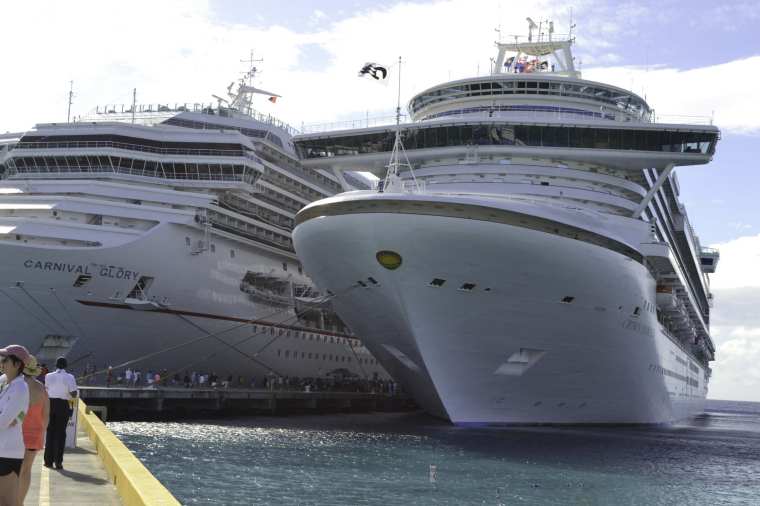
GrandTurk14

Crown Princess and Carnival Glory at Port

Conclusion

I know many of you are as eager as I am to set sail yet again, and I look forward to providing you with continuing news on the cruise shutdown. Please subscribe to my YouTube channel for further updates at: Ultimate Travel Adventures YouTube Channel!

I will also continue to provide cruise ship tours and reviews, and tours of ports-of-call both here on the blog and the YouTube channel, so I look forward to seeing you again here and there! Thanks for your support!

UPDATE: the accompanying video is UP! View it here!:

COVID-19 Cruise Update Video!


“Non-Essential” Spouses Separated by Borders During COVID-19

Medical travel concept

Pointless Passports

Immediate Family is “Essential”

I’m compelled by personal tragedy to work to increase awareness about a significant story that is not getting the attention it deserves in the media, or from the governments, at this time of Coronavirus. As you may be aware, the Canada-U.S.-Mexico borders are closed to all but “essential travelers” at this time of COVID-19. You may agree or disagree with this decision. But whether or not the general public, including shoppers and tourists, should be allowed to cross the border is beyond the purview of this post. I want to talk specifically about a category that by all standards of common sense, ethics, and moral justice, should be considered “essential travelers.” The borders should open to them immediately. This category is immediate family, specifically the spouses and children of citizens of the U.S., Canada, or Mexico.

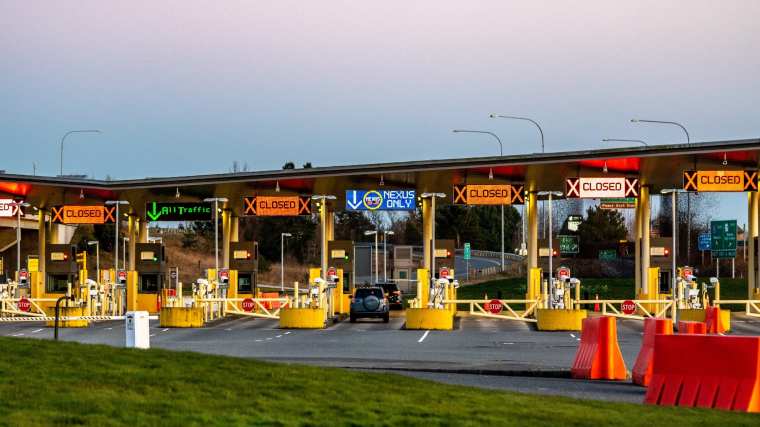
US/Canada Border, Peace Arch, Washington State, USA. Empty border lanes at crossing between US and Canada.

U.S.-Canada Border Crossing Closings

Spouses and Children: Separated by COVID-19

An untold but significant number of citizens of the U.S., Canada, and Mexico have foreign national spouses who are citizens of a neighboring country, and these people are currently being denied border crossing, despite the wording in the regulations that “essential travelers” are allowed passage during the Coronavirus outbreak. There are also an unspeakable number of children who are being denied access to their foreign national parent across the border, despite court orders enforcing visitation. This is outrageous, unconscionable, and indescribably inexcusable.

I’m an American Citizen and my newlywed husband is Canadian. We’re stranded, separated – myself in Florida and he in Ontario. Neither he nor I can cross the border to reunite right now. According to the governments, our travel is “non-essential,” our relationship disposable and irrelevant. The worst part isn’t even the separation itself – it’s the fact that we have no idea when the border will re-open or we will see each other again. It’s an agonizing waiting game, and one where I’m glued to the news desperately hoping for an update that would be encouraging in light of our desperate desire to be reunited. While the border closure was extended to June 21, it’s already been extended twice, so there’s no indication it won’t be extended again – or how many more times the border closure will be extended. Keeping immediate family separated for months on end, and with no end in sight, is extremely misguided, and, I would argue, immoral.

I don’t mean to suggest that spouses and children from countries outside of North America shouldn’t be included in the “essential travelers” category – they should. I’m only focusing on the North American numbers because the number of Canadian, American, and Mexican citizens suffering through the border closing, and separated from their immediate family members, is especially staggering due to the proximity of these three countries.

Young woman communicating with man via video call application.

“Non-Essential” Spouses

Safety Precautions Against Coronavirus are Possible

I get that governments are concerned about the Coronavirus and that they may not be ready to open to a flood of border crossings by “anyone and everyone.” But I contend that NOTHING is more important than immediate family, especially at a time like this. An exception should be made to the border closure for spouses and children of citizens, effective immediately!

I have some suggestions to include in my plea to make the plan safer. Require a 2 week quarantine for the spouses and children crossing the border. And, if necessary, download of an app to track the person could be required, to assure compliance with the quarantine. A negative test in the past 48 hours could also help if a COVID-19 test would be readily available to both parties. Although I consider these measures intrusive and an invasion of privacy that I would reject utterly under ordinary circumstances, I would gladly temper my ethical standards and comply with any of these requirements if it meant being reunited with my beloved husband.

A bad situation is being made much, much worse, and unnecessarily. There are mitigating safety measures that can be taken to allow truly essential travelers: spouses and children of citizens, to be added to the border crossing exemption, not just truckers and health workers.

There’s Other Factors, Too

Another thing to consider is that when spouses are from different countries, and share two different residences, they are more likely to have urgent business and property matters that need attention across the border. My car is stranded in Canada, and I’m stuck in the U.S. without transportation, since my husband and I came to the U.S. in his car and he was forced to return to Canada. I also have other personal property in Canada right now that I need, and don’t have, access to. This is a very complex problem with a very simple solution!!!

A Plea to Our Governments

Due to the close friendship between our countries, many, many people have developed relationships and created multi-national families, and being separated indefinitely is an extreme emotional hardship for them. A plea to our governments: you brought us together; let us stay together. Please make an exception for immediate family members to be considered “essential” travelers, and grant us permission to cross the border.

How You Can Help

First, I hope you will subscribe to my YouTube channel where I will be posting video on this issue shortly. You can find it at: Heather Anne Ultimate Travel Adventures.

Secondly, I hope you will consider signing these petitions. There is no cost, and I receive no benefit (unless it helps change the situation so I can see my husband!) There’s also an option to share the petition with others.

There’s an online petition to allow immediate family of citizens to cross the border here:

Canada: Allow Family Reunification During COVID 19

and there’s another one here:

Justin Trudeau: Love is Essential

What do you think? Do you think spouses and children of citizens should be allowed to cross the border? Please leave your comments below!